
Category: General

  • How to Choose the Best Truck Accident Attorney in Oregon

    How to Choose the Best Truck Accident Attorney in Oregon

    A semi-truck weighs up to 80,000 pounds. A passenger car weighs about 4,000. Truck accident cases are not simply bigger versions of car accident cases; they’re more complex in almost every way. Hiring an experienced lawyer matters more here than arguably anywhere else in personal injury law. Here’s how to hire the best truck accident attorney in Oregon to represent you.

    A sideswipe on I-101, a jackknife accident on Beaverton-Hillsdale Highway: large truck accidents in Oregon are a tragic reality. Most of the people who call us after a truck crash have never experienced anything like it before; they’re facing not just the pain and suffering from a traumatic event. They see medical bills arriving faster than they can open them, an adjuster who sounds perhaps a bit too friendly on the phone, and a growing suspicion that the insurance companies involved are not going to make the process easy.

    That suspicion is correct; given the injuries involved and the money at stake, national insurance carriers dispatch rapid-response investigators to the accident scene within hours, sometimes even before the road reopens. Moving quickly to settle your truck accident claim means you’ll be broadsided again: this time with an offer that dramatically undervalues your injuries—and closes your case forever.

    If you take nothing else from this blog, make it this: we strongly recommend speaking with several truck accident attorneys in Oregon before settling on the best one for you, and doing so as soon as possible. Oregon has a strict two-year statute of limitations on most truck accident cases, which is shortened to just 180 days if the accident involved a government vehicle. Act soon to protect your case.

    Here’s what to look for in an attorney for a commercial truck accident, and what red-flags to avoid when making this critical decision.

    Hire a Trial Lawyer, Not a Settlement Mill

    The single most important question you can ask when interviewing truck accident attorneys is this:

    When did you last try a truck accident case like mine to verdict?

    Plenty of firms advertise that they handle truck accident claims, and then quietly resolve every file at whatever number the carrier offers: a business model that seeks quality over quality when it comes to cases. Defense lawyers know which firms those are, and they offer proportionate minimum settlement offers because they know they’ll never have to defend themselves in court. If your lawyer has never taken a truck accident case to court, your case gets valued accordingly, regardless of how badly you were hurt.

    Experienced attorneys who actually try cases change the math before a single deposition is taken. Barton Trial Attorneys brings an illustrious trial record to every case we take, including a $3,150,000 verdict on a case involving a negligent truck driver who caused a fatal accident at a rural intersection. Trial is in our name, and we take this aspect seriously.

    Ask Them How Truck Accidents are Different from Car Accidents

    Truck accidents involve more serious injuries, more potential defendants, and larger insurance policies that are guarded aggressively. They also involve gathering evidence from the truck itself, as well as the trucking company, which requires knowing what to ask for. The truck accident attorney you hire needs to know what they’re doing or they might miss a critical evidentiary component that could compromise their case.

    Ask directly: what evidence will you gather in the first ten days? Their answer should be, if nothing else: “Send a preservation letter in the first week to protect your case.” This will preserve all of the following:

    • Electronic control module (“black box”) data
    • Hours-of-service logs and ELD records
    • Driver qualification files, training records, and prior violations
    • Dispatch communications and load pressure
    • Company safety policies
    • Phone records and app data that can establish distracted driving

    Much of this evidence has a short shelf life, and some of it a carrier is permitted to destroy on a routine retention schedule once a set period passes.

    Check Their Understanding of Common Defense Tactics

    Your truck accident claim will be challenged by the defense; this much we know. But the degree to which trucking insurance companies will minimize your case is an aspect most people—and most inexperienced attorneys—never see coming. To explain this factor, we’ll use a case study from our own trial records: Moutal v. Exel, Inc., No. 3:17-cv-01444-HZ (D. Or. Mar. 29, 2021).


    The Moutal case: “He was only going four miles an hour over…”

    In August 2016, Eric Moutal and Andrea Newman were riding bicycles legally on the shoulder of Interstate 84 near Hood River, in the Columbia River Gorge. An employee of Exel, Inc., a national trucking company, ran into them from behind with a semi-truck. Moutal’s leg was nearly severed and he was left with permanent functional deficits.

    The defense theory was a single number: four. The driver had set his cruise control four miles per hour over the posted limit; speeding alone, the defense argued, citing Oregon cases going back to 1959, “amounts to nothing more than ordinary negligence.”

    They were right about the law, but wrong about the case. Our trial team put the whole event in front of the jury, not just the speedometer:

    • The driver testified he didn’t know the posted speed limit, despite driving that stretch constantly.
    • He had been weaving in and out of the shoulder for miles; a motorist behind him testified he believed the trucker was falling asleep at the wheel.
    • The highway is dotted with “Bicycles on Roadway” signs, in place for at least a year. Despite having driven the road multiple times, the driver testified that he never saw them.
    • The motorist behind the truck could see the cyclists clearly; the truck driver claimed did not.
    • He had room to move into the fast lane, and failed to do so.

    The driver saw Moutal’s body flying through the air in his mirror, pulled over, and inspected his truck for damage. He didn’t go back to help or even call 911; he called his supervisor. He didn’t get his first-aid kit or set out his reflective triangles. A passing nurse rendered aid. Bystanders redirected traffic.

    What the driver did do was tell witnesses the cyclists were at fault, say he was worried about losing his job, and then follow those witnesses around the scene trying to get them to agree with his version. An Oregon State Trooper had to order him to leave them alone.

    Given the egregious negligence of the defendant’s actions, both before and after the collision, a federal jury awarded over $5 million in compensatory damages to the plaintiff, as well as $4 million in punitive damages: a million dollars for every mile per hour over the limit.


    The takeaway for anyone hiring an Oregon truck accident lawyer: be aware that trucking companies defend these cases by shrinking them. They will isolate the single most defensible fact and ask a jury to judge the case by that fact alone. The best truck accident attorneys in Oregon know how to beat that strategy: by telling the whole story, framing their argument well, and not being afraid to let a jury decide.

    Ask How Many Cases They Handle at Once

    This is a simple equation: more cases per lawyer means fewer hours devoted to yours. Trucking accident victims with catastrophic injuries need lawyers with ample time to investigate evidence, respond thoughtfully to the defense, and put forward the best possible case in your name. A law firm carrying hundreds of open files cannot give a serious case the attention it needs to recover compensation at full value.

    Ask how many active cases the firm has, how many lawyers will work on yours, and who will actually answer the phone when you call. At Barton Trial Attorneys, individualization is one of our Core Values. We are highly selective with the cases we take, so we can give our full attention to each client. We believe the strongest client relationship yields the best possible outcome.

    Make Sure They Understand Your Case’s Value

    A serious accident involving a commercial truck can generate damages far beyond the emergency room bill. This includes, and may not be limited to: past and future medical care; lost wages; lost earning capacity; life-care costs; pain and suffering; and loss of consortium (loss of intimacy in personal relationships).

    In Oregon, noneconomic damages in personal injury cases are not capped; the Oregon Supreme Court recently struck down a $500,000 cap as a violation of the state constitution’s remedy clause (see Busch v. McInnis Waste Systems [2020]). An Oregon truck accident lawyer who can explain the full range of your legal options, including when punitive damages may be available, is doing their job. One who quotes you a settlement number on the first phone call is not.

    Move Quickly To Protect Your Claim

    Oregon’s statute of limitations for most personal injury claims is two (2) years from the date of injury; wrongful death claims generally run three (3) years. Claims against public bodies require formal tort claim notice far sooner: just 180 days from the date of the accident. Deadlines vary with the facts, and missing one ends the case no matter how strong it is; if a truck was involved, get the timeline confirmed by a lawyer early.

    Work with Barton Trial Attorneys

    Frequently Asked Questions about Oregon Truck Accidents

    How is a truck case different from an ordinary car accident case?

    Truck accidents are different from car accidents in three major ways: the injuries are usually more severe because of the mass involved with large trucks; there are often multiple defendants (driver, motor carrier, broker, shipper, maintenance contractor, and so on); and the evidence is federally regulated and largely electronic. Federal Motor Carrier Safety Regulations create duties an ordinary motorist doesn’t have, which means more ways to prove fault.

    What should I do at the accident scene?

    Get medical attention first. If you’re able, photograph everything: vehicle positions, the truck’s DOT number, road conditions, signage, visibility markers, etc. Get names and numbers of witnesses; independent witnesses can be extremely helpful in proving your case. Stay on site until the police officers tell you that you’re free to go. Never admit fault or give a recorded statement to the trucking company’s insurer before you’ve retained a lawyer.

    The insurance company offered me a settlement. Should I take it?

    Be careful here. Early offers usually arrive before anyone could know the full extent of your injuries; they may sell it as being helpful and proactive, when what they’re actually doing is protecting their bottom line. Once you sign a release, your claim is over, even if you need another surgery next year. Always have a lawyer review any offer before accepting.

    Can I still recover compensation if I was partly at fault?

    Oregon uses modified comparative fault, which means you can still pursue compensation as long as you were not more than 50% responsible. Your recovery is reduced by your share, which is why it is critical to hire an attorney who can fully assess the other parties’ liability. Being blamed by the trucking company at the scene doesn’t decide anything.

    Do I have to pay my truck accident lawyer up front?

    Reputable personal injury firms handle vehicle accidents on contingency; this means you pay no fee unless there’s a recovery. Ask what percentage, whether it changes if the case is filed or tried, and how case costs are handled. Studies repeatedly show that represented claims resolve for more money, even accounting for legal fees, than unrepresented claims.

    Truck Accident in Oregon? Talk to Barton Trial Attorneys

    Choosing an attorney after a truck crash comes down to a simple question: If this case has to be tried, is this the firm I want standing up in front of the jury? Barton Trial Attorneys stands by our over four decades of legal work. We handle complicated and catastrophic trucking cases nationwide, with results that speak for themselves. If you or someone you love has been injured in a truck accident in Oregon, we urge you to get in touch.

  • Systemic Medical Failures in Rural Hospitals

    Systemic Medical Failures in Rural Hospitals

    Rural hospitals comprise about 35% of all medical centers in the US, and are held to the same standards of large urban hospitals. When medical malpractice occurs in a rural hospital, it is often the result of a foreseeable systemic failure. This blog explores more on this topic, with some best practices to consider if you believe you have experienced medical malpractice in a rural hospital.

    A rural hospital is rarely negligent the way a single doctor is negligent. There’s often no singular moment where a medical professional makes a reckless choice, but instead there’s a chain of unfortunate events leading to a tragic—and fully preventable—conclusion. Examples of such conditions include things like:

    • An obstetrics unit operating without full staffing
    • A nurse covering more patients than he can reasonably attend to
    • An on-call specialist who is an hour away
    • A transfer request that sits for ninety minutes in the midst of a shift change

    No one issue constitutes medical malpractice in full, but the chain is what medical malpractice lawyers call a systemic failure: the system designed to protect our most vulnerable fails when it is needed most. In Oregon, as in most of rural America, rural hospital closures, and instances of systemic failure, have grown concerningly frequent.

    When families are hurt by a system that fails them, they often blame themselves. Many of our rural clients hesitated calling us because at first they accepted that the local hospital did the best it could. Sometimes that’s true; other times, it isn’t. The question is not whether or not a small hospital has the same resources as a large one, but whether the hospital knew its limits and failed to provide competent care anyway.


    Did I experience medical malpractice at a rural Oregon hospital?

    Without reviewing the medical evidence, it may be practically impossible to know if you were the victim of medical malpractice. Cases like this rely on fetal monitoring strips, chart notes and testimony under oath. If you believe you received insufficient care that resulted in a serious injury, call Barton Trial Attorneys immediately: (541) 265-5377.

    The Grim Financial Outlook of Rural Hospitals

    The numbers are not subtle: only 41% of rural hospitals nationally offer labor and delivery services.  For pregnant women who lose local access, roughly 70% now face more than a half-hour drive to the nearest alternative, and about 20% face more than fifty minutes. In Malheur County, for example, the nearest birth center is more than fifty miles away, in Boise, Idaho. Of the 21 rural Oregon hospitals still delivering babies, most are over fifty miles from the next closest birth center.

    Rural hospital closures in Oregon fit squarely within this trend. Saint Alphonsus Medical Center in Baker City closed its labor and delivery department in August 2023. (In April 2024, a Baker City mother gave birth in a car twenty minutes into that drive; her newborn had fluid in her lungs and initially could not breathe.) Additional Oregon rural hospital closures include Providence Seaside, McKenzie-Willamette Medical Center, Ashland Community Hospital and Vibra Specialty Hospital in Portland.

    The financial picture behind this is equally blunt. More than 70% of all Oregon hospitals recently reported operating at negative or minimal margins, and the statewide average operating margin was -0.5% in 2024. St. Charles Madras loses roughly $1 million a year on labor and delivery alone. In 2026, Oregon distributed $37.5 million in state and federal funds across 21 rural hospitals to keep maternity care from folding entirely.

    When Systemic Failure Becomes Medical Negligence

    Medical standards of care take into account the relative size and budget of a rural hospital. They do not require a rural hospital to have a neonatologist on site, a 24-hour interventional cath lab, a pediatric ICU, or a level-one trauma center. However: the hospital and its providers are unequivocally required to recognize what they cannot handle and move the patient before it’s too late.

    Here are the most distinctions that result in medical malpractice. (This is not an exhaustive list, but rather an overview of issues we look for as medical malpractice attorneys.)

    1. Delayed transfer. When a patient presents with a condition that exceeds the facility’s capability (for example: a placental abruption, a stroke inside the thrombolytic window, a ruptured aneurysm, or sepsis) the decision to transfer should be made immediately. In birth injury cases, the delay is often measured against the decision-to-incision standard for an emergency cesarean.
    2. Understaffing. Rural emergency departments increasingly run on locum doctors, advanced practice providers, and telemedicine coverage, with the specialist “available” by phone from another county. Oregon’s hospital staffing law sets nurse staffing requirements and a complaint and enforcement process; staffing plans, variance logs, and OHA complaint records are discoverable, and they can show a pattern of insufficient medical care.
    3. Communication issues. Between the emergency department and the receiving hospital, nursing shifts, on-call physicians and locum aides, communication should transfer consistently. This allows fetal monitoring strips to be read correctly, and lab tests to be acted upon expeditiously.
    4. Corporate and administrative decisions put profit over people. We know that the profit margin is razor-thin at rural hospitals, but that is no excuse to provide subpar medical care. When service lines are cut, units close, positions remain unfilled, and equipment is not replaced, these budget-sensitive decisions can lead to a worst-case scenario.


    EMTALA: Emergency Medical Treatment and Labor Act

    The federal Emergency Medical Treatment and Labor Act applies to any hospital with an emergency department that participates in Medicare. It requires an appropriate medical screening examination, stabilization within the facility’s capability, and an appropriate, timely transfer when the facility can’t stabilize the patient.

    EMTALA also expressly covers women in active labor. A hospital that has closed its obstetric unit but still runs an emergency department still has EMTALA obligations when a laboring patient walks through the door. That is exactly the scenario Oregon’s closures keep creating.

    EMTALA is not a substitute for a state medical negligence claim, and it has its own procedural rules. But documented EMTALA problems — an inadequate screening exam, a transfer without stabilization, a refusal to accept a transfer at the receiving hospital — frequently mark where the record needs looking at.

    Legal Hurdles to Bringing a Successful Medical Malpractice Case against a Rural Hospital

    Scattered records

    Rural medical malpractice cases face several known obstacles: ones we know well as Oregon medical malpractice attorneys. Records are scattered across multiple facilities, and constructing the timeline may require multiple calls, visits and depositions.

    Conservative juries

    Juries in small counties may know the hospital, and may be related to people who work there; it’s often the largest employer for fifty miles. Defense counsel will argue, sometimes persuasively, that everyone did their best with what they had.

    Expensive case preparation

    And these cases are expensive. Proving causation in a birth injury or delayed diagnosis case requires multiple qualified experts in obstetrics, neonatology, neuroradiology, life care planning, economics. That investment must come before any recovery.

    Deadlines to Filing a Medical Malpractice Claim in Oregon

    Oregon’s general statute of limitations for medical negligence is two (2) years from when the injury was discovered or reasonably should have been discovered, subject to an outside limit of five (5) years from the date of the treatment. Wrongful death claims generally run three years. Claims involving injured minors have their own rules, which can extend the window, but not in every circumstance.

    If the hospital or provider is a public body such as a county health district, a public university hospital, or a rural health district, Oregon’s Tort Claims Act requires formal notice within 180 days of the injury. Miss that and a strong case can end before it starts. A significant number of rural Oregon hospitals are publicly owned.


    The Barton Difference: We Argue Stories, Not Just Facts.

    We’re not just trial lawyers; we are master storytellers who advocate for honest, everyday people who have been injured through another person’s negligence. We understand the complex language of law, but we speak in plain English so our clients, and our juries never feel out of their depth. A strong case doesn’t need embellishment or fancy words; it needs an honest client and a competent storyteller. Bill and Brent are honored to represent Oregon families all across the state.

    We encourage you to learn more about our Core Values and read our Testimonials. When you’re ready to contact us, we’ll be here.

    Frequently Asked Questions about Rural Medical Malpractice Claims

    Is a small rural hospital held to a lower standard than a big city hospital?

    In terms of medical outcomes: no. It isn’t required to have resources it doesn’t have, bu it is required to know its limitations and to transfer appropriately when a patient needs more than it can provide. Medical specialists working in a rural hospital are generally held to the standard of their specialty regardless of where they practice.

    The hospital near me closed its maternity unit and my child suffered a birth injury as a result of having to travel for care. Do I have a case?

    This depends on the circumstances of the case. Closing a unit is a business decision and not, by itself, negligence. But what happened during and after that drive may well be: whether the closing hospital’s emergency department met its EMTALA and screening obligations, whether prenatal risk was properly assessed and a delivery plan made, whether transport was arranged appropriately. It’s worth having reviewed.

    Everyone at the hospital was kind to me, but extremely overworked. Do I have to accuse them of something?

    You do not have to accuse the treating doctors for a successful medical malpractice claim. Many of these cases are ultimately about institutional decisions like staffing levels, closed service lines, missing protocols, and absent transfer agreements. Identifying what actually failed is part of the investigation your birth injury lawyer will take on.

    Did medical understaffing cause my child’s birth injury?

    That’s a causation question and it requires expert review of the records. In some cases the injury was already irreversible before anyone could have acted; in others, however, a documented ninety-minute gap is the difference between a healthy infant and a child facing a lifetime of care.

    What does it cost to have my case reviewed by an Oregon birth injury lawyer?

    The team at Barton Trial Attorneys reviews all cases at no cost, and collects no fee unless there’s a recovery. Case costs are advanced by the firm, so you assume no financial risk by talking with us.

    What information should I gather before calling a medical malpractice lawyer?

    Request your complete records from every facility involved, including the ambulance or air medical service, and write down the timeline while you remember it. Be sure to include details like when you arrived, when you were seen, when you noticed something was wrong, when anyone said the word “transfer.” We encourage you to do this as soon as possible, before your memory fades.

    Medical Malpractice at a Rural Hospital? Call Barton Trial Attorneys

    We understand that rural hospitals are under financial pressure, and the people who work in them are largely doing difficult work under challenging conditions. While the system may be failing, that is no excuse to not provide a consistent standard of care to all patients. When specific, documented decisions at a rural hospital result in injury, we’re here to help balance the scale.

    Barton Trial Attorneys handles catastrophic birth injury and medical malpractice cases across Oregon and nationwide, taking just ten cases or fewer at a time. If your family was hurt at a rural hospital, or during a transfer that came too late, we urge you to call for a confidential case review: (541) 265-5377. There is no fee unless we recover for you.

  • Bill reprises his role as Supreme Court Justice Oliver Wendell Holmes, Jr.

    Bill reprises his role as Supreme Court Justice Oliver Wendell Holmes, Jr.

    “How to Make a Life in the Law,” is a one-man show and historic creation based on one of the nation’s great judges and one of the 19th century’s most popular authors. Bill has meticulously studied the life and writings of Oliver Wendell Holmes, Jr. and delights audiences by bringing his unique perspective, signature directness, and character to life, relating in the first-person Holmes’ significant impact on the US Constitution, social thought, and legal policy as we know it, as well as fielding questions in-character on issues as contemporary and diverse as Obamacare and same sex marriage.

  • Rogue Nation Honors Bill with Promotion to “Global Ambassador” for the Brand

    Rogue Nation Honors Bill with Promotion to “Global Ambassador” for the Brand

    For more than five years now, Bill has been tapped by Oregon craft brewer Rogue Ales both as an advisor, and as Chief Brand Socializer. The company leverages Bill’s passions for authenticity and storytelling to train new employees in how to communicate the brand. In February his service to the company was acknowledged with a promotion to Rogue “Global Ambassador.” Prior he’d been named, “Ambassador at Large.” We’re sure there are more perks involved.

  • Who is That on That 10 Hopoe Bill?

    Who is That on That 10 Hopoe Bill?

    On a bill? That would be Bill. Beginning in 2009, Rogue Nation, Oregon’s eclectic beer, spirits, and hospitality powerhouse began issuing its currency honoring our own Bill Barton for all his support of the Rouge Brand and the business community in Newport, home of Rogue World Headquarters. Bill gladly hands out his namesake, talking up Rogue all the while. “That’s real money, there…don’t forget to use it,” he says. And so the Rogue legend grows.

  • Bill Honored with Owen Panner Professionalism Award by the Oregon State Bar

    Bill Honored with Owen Panner Professionalism Award by the Oregon State Bar

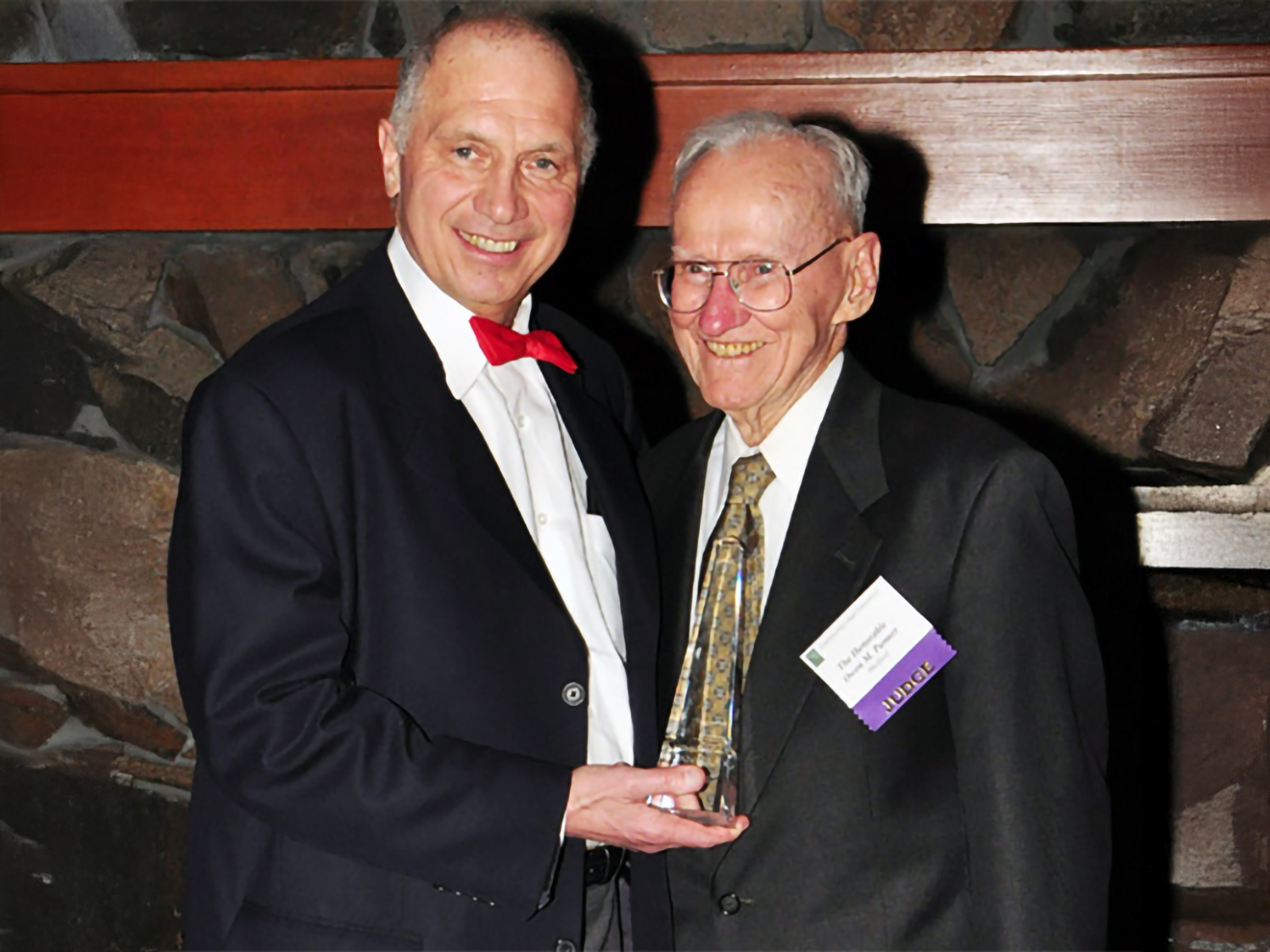
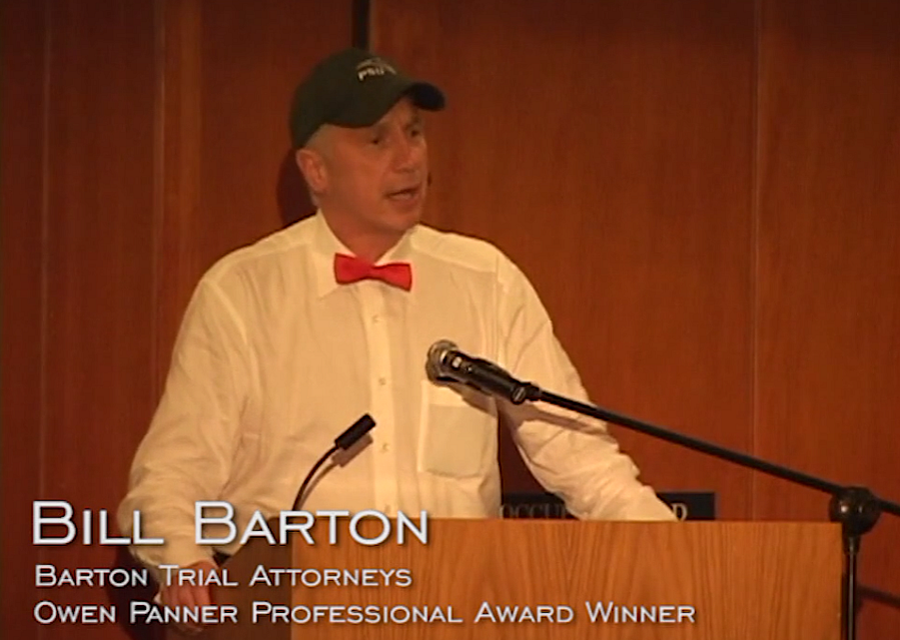
    “Not only is Bill the recipient of this award, but he is the epitome of this award,” said Judge Owen Panner, namesake of the Oregon State Bar’s Professionalism Award. Bill received the 2013 Owen M. Panner Professionalism Award, the top recognition in the state for personal and professional standards and the furthering of the legal profession. Selected by a jury of peers from both sides of the bar, the award was presented at the annual banquet of the Litigation Institute and Retreat.

    Judge Panner, a longtime friend, personally presented the award to Bill. Diverse speakers, including his son and business partner Brent Barton, Peter Richter of Miller Nash, and Anthony Owens, the assistant men’s basketball coach from PSU, toasted Bill commenting on his unparalleled trial skills, unique personality, and deep commitment to law, mentorship, and friendship. “It would be safe to say that Bill honors this award more than the award honors him,” said Judge Panner.

  • “Serving Time” on Behalf of Others

    “Serving Time” on Behalf of Others

    With a commitment to social justice, community, and service, Bill and Brent provide legal aid and pro bono services—as well as countless volunteer hours—to various nonprofits in our Newport and Portland communities, and around the state.

    • Bill serves on the Advisory Counsel for Lincoln County Legal Aid and is a past member of the Commission on Judicial Fitness and Disability.
    • Brent has served on the Oregon Criminal Justice Commission and the Classroom Law Project; volunteers time for nonprofits like the Oregon Humane Society, and Clackamas Children’s Center; and has served on the boards of the Portland Opera and Oregon Ballet Theatre. He was also appointed to serve on the Willamette River Cleanup Authority’s commission.
  • Brent Barton Serves on Oregon Criminal Justice Commission

    Brent Barton Serves on Oregon Criminal Justice Commission

    In 2009-10 Brent served on the Oregon Criminal Justice Commission, a governmental body seeking to implement evidence-based practices in Oregon criminal law. The commission provides a centralized and impartial forum for statewide policy development and planning with the aim of improving the efficiency and effectiveness of state and local criminal justice systems, and develops long-range public safety plans for state prisons, jails, and corrections programs.

    Read more about the Oregon Criminal Justice Commission.

  • Bill and JoAnn Barton Endow SEAL Scholarship Program

    Bill and JoAnn Barton Endow SEAL Scholarship Program

    Bill and JoAnn Barton founded the Barton Family Serve, Earn, and Learn (SEAL) Scholarship Program at Oregon Coast Community College this year because of their belief in the power of education and their desire to bring hope and a spirit of service to current and future OCCC students. The fund provides financial assistance to deserving students at OCCC in exchange for their service to many of the college’s departments.

    The Bartons made a generous donation of $300,000 to the OCCC Foundation, with $280,000 set aside as an endowment fund to perpetuate the scholarship. Annual SEAL recipients are supported in their pursuit of a higher education, relieved of some of their educational loan debt, and actively mentored by instructors and staff. They complete on-campus service assignments—45 to 72 hours per term—which increase their work experience, foster career development, and increase their chance of student success. Students benefit from work experience in the nursing skills lab, science labs, tutoring center, small business development center, students services, facilities, and the library.

    Since the Barton’s original founding gift, the OCCC Foundation has received additional funding for the SEAL Scholarship Program from the Siletz Tribal Charitable Contribution Fund, the Estate of Alline McAlister, and a generous gift from Mr. John Sherman.